Recent Yogi Bhajan Lecture Articles (Page 4)

Yogi Bhajan Lecture: Happy 31st Anniversary to 3HO!
In this lecture excerpt, Happy 31st Anniversary to 3HO!, Yogi Bhajan talks about how 3HO has grown over the years, coming challenges, and the importance of keeping up together in truth, grace, and service. This lecture was given on January 5, 2000. Today we are celebrating 3HO’s birthday. It is the change of the Age into another era. 3HO Foundation (Healthy, Happy, Holy Organization) came into existence, and it started giving people self-improvement, self-empowerment, self-knowledge, and self-experience. Many years ago, we all started functioning toward one thing: we want to experience, we want to grow, we want to see. The nation revolted. The revolution was…
Read: Yogi Bhajan Lecture: Happy 31st Anniversary to 3HO!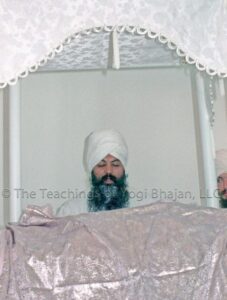
Yogi Bhajan Lecture: Guidance of the Guru
In this lecture excerpt, Guidance of the Guru, Yogi Bhajan explains the concepts of Guru and inner guidance. This lecture was given on April 2, 1995, in Los Angeles, CA. There is a balance on this Earth. There is a balance in time. There is a balance in space. There is a balance in Earth. Every moment is in balance. Good and bad are in balance. Light and darkness are in balance. Guru takes us from darkness to light in balance. It is not properly understood what a Guru is. When you are consciously in command of your life, that is Guru. You consciously live,…
Read: Yogi Bhajan Lecture: Guidance of the Guru
Yogi Bhajan Lecture: I, the Self, Call on My Psyche
In this lecture excerpt, I, the Self, Call on My Psyche, Yogi Bhajan gives us a way to tune into our intuition. This lecture was given on March 8, 1995. When we do not have consciousness, we do not have basic intuition. The problem is that intuition has to be developed. It is there but is dormant. Everybody is not intuitive—you can be intuitive but you are not. That’s why they say the soul is dormant. And dormant soul means that you are alive but you live by impulse. When you don’t control your impulse, you have no intuition. And when you…
Read: Yogi Bhajan Lecture: I, the Self, Call on My Psyche
Yogi Bhajan Lecture: The Little Voice Inside
In this short lecture excerpt, The Little Voice Inside, Yogi Bhajan is talking about intuition. This lecture was given on July 20, 1994. Intuition tells you what is for you. The little voice inside is a very powerful thing. It tells you exactly what it is. It will tell you if it’s not right, avoid it. Normally, you don’t avoid it; you let it slide. Intuition will always tell you what will protect you and what is best for you. If you are not intelligent, you will slide into some pit where you cannot come out. Intuition can only tell you,…
Read: Yogi Bhajan Lecture: The Little Voice Inside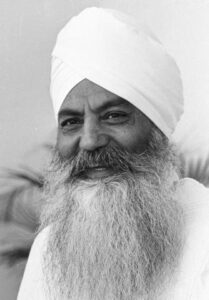
Yogi Bhajan Lecture: Be Contained Within Your ‘You’
In this lecture excerpt, Be Contained Within your ‘You’, Yogi Bhajan says that it is being secure and contained within yourself that brings true contentment. This lecture was given in Los Angeles on March 1, 1989. Take any religion, take any teachings, deal with anything—there is only one thing: you should become you, complete and competent. That’s the process. Life will have no other process but that. Your problem is that to keep alive inside, you use emotions, feelings, sex, and all that you can feel. Those who know the inside, know the entire outside. Those who know outside do…
Read: Yogi Bhajan Lecture: Be Contained Within Your ‘You’
Yogi Bhajan Lecture: Inner Guidance and the Mind
In this lecture excerpt, Inner Guidance and the Mind, Yogi Bhajan explains the importance of learning to discipline the mind so that you can be in tune with your own inner guidance. This lecture was given on June 25, 1987 at Summer Solstice at Ram Das Puri, NM. (View the full video lecture below). I would like to talk to you about something―if you have mind to listen to it. I know all of you, young or old, will go through every phase of life. With all the energy you have, there will be certain things which happen to you. Can…
Read: Yogi Bhajan Lecture: Inner Guidance and the Mind
Yogi Bhajan Lecture: Celestial Communication and Relaxation
In this lecture excerpt, Celestial Communication and Relaxation, Yogi Bhajan explains the relaxing power of Celestial Communication and has the class do several songs with it. This lecture was given on August 27, 1985, in Los Angeles, CA. Now we hear the song “Himalaya” and you will have the celestial movement with it to relax yourself. Everybody should sing and participate with this, clean and pure. (Class sings and then tape ends) This was a Celestial Communication. When you cannot take care of your neurosis by any known method, do just a few minutes of it. There is no power…
Read: Yogi Bhajan Lecture: Celestial Communication and Relaxation
Yogi Bhajan Lecture: Welcome Your Tomorrow
In this lecture excerpt, Welcome Your Tomorrow, Yogi Bhajan says living in fear puts pressure on the body. We ruin our tomorrow by worrying about it. This lecture was given on August 21,1985 in Los Angeles, CA. Sometimes it is winter, sometimes it is summer, fall, or spring, but all four seasons come from the same Earth by its orbit around the Sun. We have day and night; it is from the movement of the Earth around its axis. If we look into that aspect of the Universe, you will find a similarity in how much fear plays a part…
Read: Yogi Bhajan Lecture: Welcome Your Tomorrow
Communication: Its Psychology and Practical Knowledge
Lecture by Yogi Bhajan on June 30, 1985, at KWTC (Khalsa Women’s Training Camp) Sit and be Sacred Teree meher daa bolnaa Tudh agai ardaas Guru Guru Wahe Guru Guru Ram Das. Aad gure nameh Jugaad gure nameh Sat gure nameh Siree guru deve nameh. Wahe Guru ji ka Khalsa Wahe Guru ji ki Fateh. The cost we are paying to become human is not the cost we should be paying. The cost we are paying to be happy is not the cost we should be paying. What is going on today is very strange environments. We are all behaving…
Read: Communication: Its Psychology and Practical Knowledge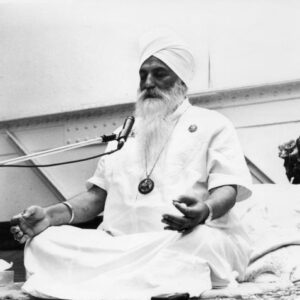
Yogi Bhajan Lecture: Developing Intuition
In this lecture excerpt, Developing Intuition, Yogi Bhajan tells how the mind can be trained so you are always in touch with your intuitive guidance. This lecture was given on February 21, 1978. When the mind is set to be intuitive, and you develop it, it is an investment. It is as good an investment as your hair-do, as your good clothes, as your good language. And then whenever you want the answer to something, you don’t have to call on anything. You have to call your own computer. Just stop yourself. And in the click of moments, your own self will talk…
Read: Yogi Bhajan Lecture: Developing Intuition