Yogic Massage is a spiritual technology of touch taught through the teachings of Yogi Bhajan. It bridges the yogic understanding of subtle energy with modern insights into the nervous system and the body’s natural ability to heal. In its essence, Yogic Massage is meditation in motion: breath, mantra, and touch combining to awaken the pranic current—the life force that animates everything.
Estimated reading time: 7 minutes
Table of contents
- The Origins of Yogic Massage in Yogi Bhajan’s Teachings
- What Happens Inside the Body
- The Energetic Dimension of Yogic Massage
- The Therapist as Channel
- Physiological and Emotional Benefits of Yogic Massage
- It is a Meditation in Motion
- Living the Principles of the technique
- Contraindications and Care
- Next steps

The Origins of Yogic Massage in Yogi Bhajan’s Teachings
Within Yogi Bhajan’s comprehensive teachings on human consciousness, he often spoke of the miracle of healing hands. He taught that true healing doesn’t happen from us but through us. In The Miracle of Healing Hands by Waheguru Singh Khalsa, these ideas are expanded into what he calls the Three Laws of Healing: presence, prayer, and polarity.
Presence means the therapist must be fully embodied and inwardly still. Prayer is the vibrational field of love and service that infuses every gesture. Polarity refers to the flow of prana—energy moving between two poles, like current through a circuit. When the therapist’s hands and heart are aligned, that circuit completes and healing occurs spontaneously.
In this way, Yogic Massage becomes a dialogue between two souls rather than a manipulation of muscles.
What Happens Inside the Body
Modern research is finally catching up with what the yogis have known for centuries: mindful touch changes the body at every level.
A 2022 review in Frontiers in Neuroscience revealed that conscious touch activates specialized nerve fibers known as C-tactile afferents—pathways that communicate directly with emotional regulation centers in the brain, inducing feelings of safety, empathy, and connection. Another study in Complementary Therapies in Medicine (2011) showed that massage therapy decreases cortisol while increasing serotonin and dopamine. These are not just “feel-good” chemicals—they reset the entire autonomic nervous system.
In Yogic Massage, the effect goes deeper because breath, mantra, and intention guide every movement. When the practitioner’s breathing rhythm syncs with the receiver’s, a phenomenon called cardiorespiratory coherence arises. Studies on paired meditation have shown that two heart rates can synchronize when intention and focus align. This resonance creates a field where the body naturally shifts into parasympathetic dominance—the state of healing, digestion, and regeneration.
At the physical level, circulation improves, fascia (the connective tissue network) becomes more pliable, lymphatic drainage increases, and immune function strengthens. In the biochemical level, oxytocin—the bonding hormone—rises, encouraging trust and emotional release.
Looking into the energetic level, the chakras open, prana flows, and the aura expands. Science calls it homeostasis; yogic science calls it balance of the ten bodies.
The Energetic Dimension of Yogic Massage
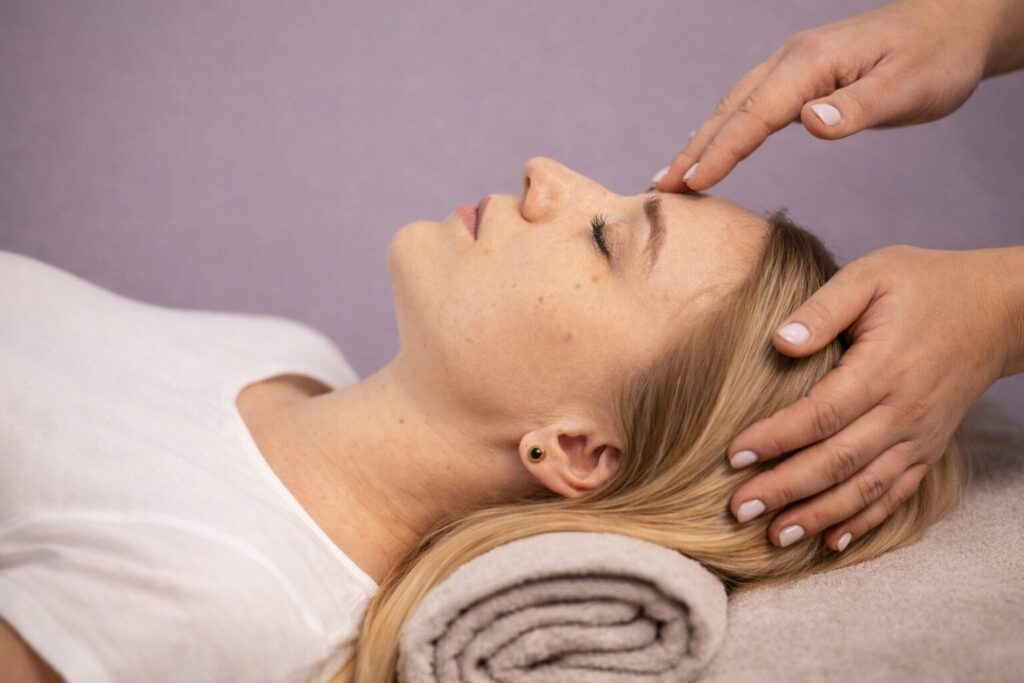
Energetically, a Yogic Massage session is a dance of prana between giver and receiver. Both enter a meditative field where boundaries soften and awareness expands. The practitioner’s hands, warmed by breath and mantra, become radiant instruments. Recipients often report sensations of heat, pulsation, or waves of subtle light moving through them.
According to The Miracle of Healing Hands, when the therapist balances their own field, their energy naturally harmonizes the receiver’s through resonance rather than effort.
. This idea aligns with biophysics research on electromagnetic communication between cells—suggesting that the human biofield may operate as a quantum-coherent system.
When an emotion, memory, or blocked sensation rises during the session, it’s a sign that prana is reorganizing itself. The body, given permission to feel safely, releases stored tension. In trauma therapy, this is called somatic integration; in yogic language, it is karma clearing—the gentle dissolution of old energetic impressions.
The Therapist as Channel
Yogic Massage begins long before any physical contact. The therapist prepares not only the space but their own energy. Yogi Bhajan often emphasized: “Your state of consciousness is your most powerful healing tool.”
Before each session, the practitioner may meditate on the Ra Ma Da Sa Sa Say So Hung mantra—the healing sound current that aligns individual energy with the cosmic frequency. Breathing practices such as long deep breathing or alternate nostril breathing stabilize the nervous system and open the heart center.
In The Miracle of Healing Hands, a chapter titled Preserving Your Energy and Stamina reminds healers that neutrality is essential. Healing energy flows best when the mind is clear of judgment or expectation. Neutrality doesn’t mean disconnection—it means deep presence without attachment to outcome.
The physical space mirrors that inner clarity: soft light, clean air, subtle fragrance, devotional music. Environmental psychology supports this yogic approach—studies confirm that sensory coherence enhances parasympathetic response. The room itself becomes part of the medicine.
Physiological and Emotional Benefits of Yogic Massage
From my experience and what both science and the yogic lineage describe, Yogic Massage offers benefits that ripple through every dimension of being:
Physical:
It releases chronic tension, improves circulation, supports joint mobility, and enhances detoxification through lymphatic flow.
Neurological:
By stimulating the vagus nerve, Yogic Massage improves heart-rate variability and regulates the stress response. Regular practice has been shown to enhance emotional resilience and sleep quality.
Energetic:
It balances the chakras, clears the nadis, and strengthens the auric field—what yogic tradition calls the electromagnetic shield of consciousness.
Emotional and Spiritual:
Touch infused with mantra activates oxytocin and endorphins, bringing feelings of safety and joy. More importantly, it reconnects you to your soul’s innate harmony—the state of Sat Nam, true identity.
Recent research in The Journal of Integrative Medicine (2023) found that touch-based mindfulness interventions improved immune markers and emotional regulation, suggesting that conscious bodywork acts as a “psychophysiological bridge” between body awareness and spiritual well-being.
It is a Meditation in Motion
During Yogic Massage, every movement follows the breath. Each stroke mirrors the rhythm of life itself—expansion and contraction, giving and receiving. The practitioner listens with the hands, moving not from effort but from intuition. The pauses between motions are as meaningful as the motions themselves.
Yogi Bhajan taught that “Meditation is not confined to stillness. It is the state of awareness within action.” Yogic Massage is precisely that: meditation expressed through service. It is Karma Yoga—selfless action infused with consciousness.
For the practitioner, it cultivates humility, compassion, and deep listening. For the receiver, it invites surrender and trust. Together, they create a shared field of awareness where healing emerges naturally.
Living the Principles of the technique
Yogic Massage doesn’t end when the session is over. Its essence can infuse daily life.
Touch your surroundings with mindfulness—whether washing dishes, embracing a friend, or tending your own body. Notice your breath as you move. This is living Yogic Massage: transforming every gesture into meditation.
If you feel called to share this art professionally, study within the 3HO Foundation or with teachers trained in Yogi Bhajan’s lineage. These programs emphasize both technique and spiritual ethics—ensuring the healer serves as a clear vessel rather than an egoic performer.
To practice Yogic Massage is to live in the vibration of Seva—sacred service—and to let every act of touch become an act of devotion.
Contraindications and Care
Like any healing art, Yogic Massage requires discernment. It complements but does not replace medical care. Avoid direct massage on acute injuries, infections, or inflammatory conditions without professional guidance. When in doubt, consult a physician.
Energetically, practitioners must care for themselves—grounding after sessions, cleansing their field through cold showers (Ishnaan), breath of fire, or short meditations. Only a centered healer can hold space for others’ transformation safely.
Next steps
If you feel inspired to explore Yogic Massage further, here are gentle ways to deepen your connection:
- Begin a daily practice of conscious touch.
Place your hands on your heart or belly and breathe long and deep for 3 minutes. - Incorporate mantra into your self-care.
Try chanting Ra Ma Da Sa for 5–11 minutes to cultivate healing frequency. - Practice presence throughout the day.
Notice your breath while walking, cooking, or interacting with others. This is living Yogic Massage. - Receive or offer short, mindful touch sessions.
A simple shoulder or hand massage given with awareness can shift mood and energy instantly. - Consider studying the lineage-based techniques.
Look for certified teachers connected to the teachings of Yogi Bhajan or the 3HO Foundation.
Resources
Where to Buy the Book
The Miracle of Healing Hands by Waheguru Singh Khalsa
Available here on Amazon:
https://www.amazon.com/Miracle-Healing-Hands-Waheguru-Khalsa/dp/0965849740
Your experience is important!
Share your wisdom with others like you. Leave your comment below