Kundalini Yoga originates from the ancient yogic tradition of India, where it was passed down for thousands of years from teacher to student as a sacred science of awareness. Its purpose is to awaken human potential and unite the finite with the Infinite. From this foundation, yoga becomes a practical system to refine perception, balance the mind, and anchor identity in the Higher Self.
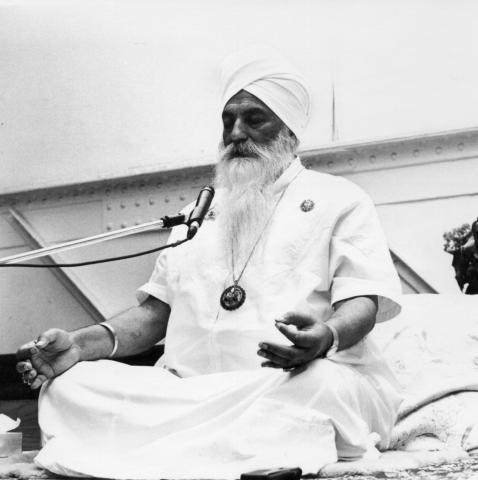
In 1969, Yogi Bhajan introduced Kundalini Yoga to the West, making these once-esoteric teachings accessible to everyone. Known as the “Yoga of Awareness,” it combines breath, movement, mantra, and meditation to cultivate clarity, presence, and purposeful action.
Estimated reading time: 4 minutes
Table of contents
Kundalini Yoga as a Natural Unfolding
The journey unfolds step by step. First, the heart awakens devotion. Next, strength and skill build the ability to direct energy. Finally, the Self rests in steady sovereignty. From that place, life flows with sahej—an ease where opposites lose their sting, knowledge becomes direct, and service stops being performance. Service becomes our natural way of moving through the world.
Yogi Bhajan and the Modern Transmission of Kundalini Yoga
While Kundalini Yoga has deep roots in the Raj Yoga tradition and the House of Guru Ram Das, its modern introduction to the West came through Siri Singh Sahib Bhai Sahib Harbhajan Singh Khalsa Yogiji—known as Yogi Bhajan.
In 1968, Yogi Bhajan began teaching Kundalini Yoga publicly in North America. At the time, yoga was often seen only as physical exercise, but he shared it as a complete lifestyle practice. His vision was not only to preserve the ancient teachings but also to make them accessible to modern householders—people with families, jobs, and responsibilities.
Through his work, the teachings spread globally. He founded 3HO (Healthy, Happy, Holy Organization) in 1969, rooted in the idea that everyone has the birthright to live healthy, happy, and holy. Under his guidance, Kundalini Yoga grew into an international movement, practiced in communities and taught by certified instructors worldwide.
The House of Guru Ram Das
How did this stream of practice reach us? The transmission most associated with modern Kundalini Yoga is carried in what practitioners call the House of Guru Ram Das.
In North India, Baba Siri Chand—respected yogi and son of Guru Nanak—recognized that the light of Raj Yoga needed a trusted steward. He entrusted this responsibility to Guru Ram Das, the fourth Sikh Guru, known for humility and compassion. From then on, the teachings were said to rest in this “house,” not as hidden secrets but as virtues to be practiced and shared.
A Path for Householders
What defines this lineage is its stance. The teacher’s role is not to become the student’s ultimate identity. Rather, it is to lead each person back to their own Infinite Identity.
The teachings are not secret. They are open and meant for practice in daily life. Kundalini Yoga was designed for householders—people with families, jobs, and responsibilities. Awakening does not happen apart from life but woven into it.
Within this home of practice, a mantra keeps the heart steady: Guru Guru Wahe Guru, Guru Ram Das Guru. Practitioners use it for humility and protection. Its message is simple: don’t grasp for credit and don’t carry the blame. Let grace hold both title and weight so you can keep serving.
Sant Hazara Singh and Character Training
Another figure linked to this transmission is Sant Hazara Singh, known for shaping strong character in his students. His training emphasized deep commitment, obedience to the soul, and courage without theatrics.
From his teaching comes a caution about siddhis, or extraordinary abilities that can appear with practice. His message was clear: do not create causes without necessity. Every cause brings consequences, and no one escapes that law. Power must be carried with humility, or it will spill what it was meant to protect.
The Origin and Aim of Kundalini Yoga
So, where did Kundalini Yoga originate? It springs from the timeless root of yoga—union—and comes to us through a living lineage framed as Raj Yoga. Safeguarded in the House of Guru Ram Das, it was passed forward not for spectacle but for service.
Its aim is conscience: to cultivate devotion, discipline, and the sovereign presence that allows us to act with clarity in everyday life. When we breathe, meditate, chant, and serve from that stance, we participate in the origin here and now—turning human experience itself into the field where yoga’s root blooms.
More Frequently Asked Questions
- Can Kundalini Yoga Change Your Life?
- How Kundalini Yoga Is Different
- How Kundalini Yoga Works
- Is Kundalini Yoga a Religion?
- Is Kundalini Yoga Dangerous?
- Is Kundalini Yoga Hard?
- Kundalini Awakening
- Kundalini Yoga Benefits
- When Was Kundalini Yoga Invented?
- Who invented Kundalini Yoga
Your experience is important!
Share your wisdom with others like you. Leave your comment below